
If it is happening now
- Switch the system off at the thermostat. It makes water for as long as it runs.
- Do not push on a sagging ceiling. Put a container under it and stand clear.
- Keep away from light fixtures and outlets in the wet area.
- Move what you can off the wet floor and photograph everything first.
How a condensate leak starts
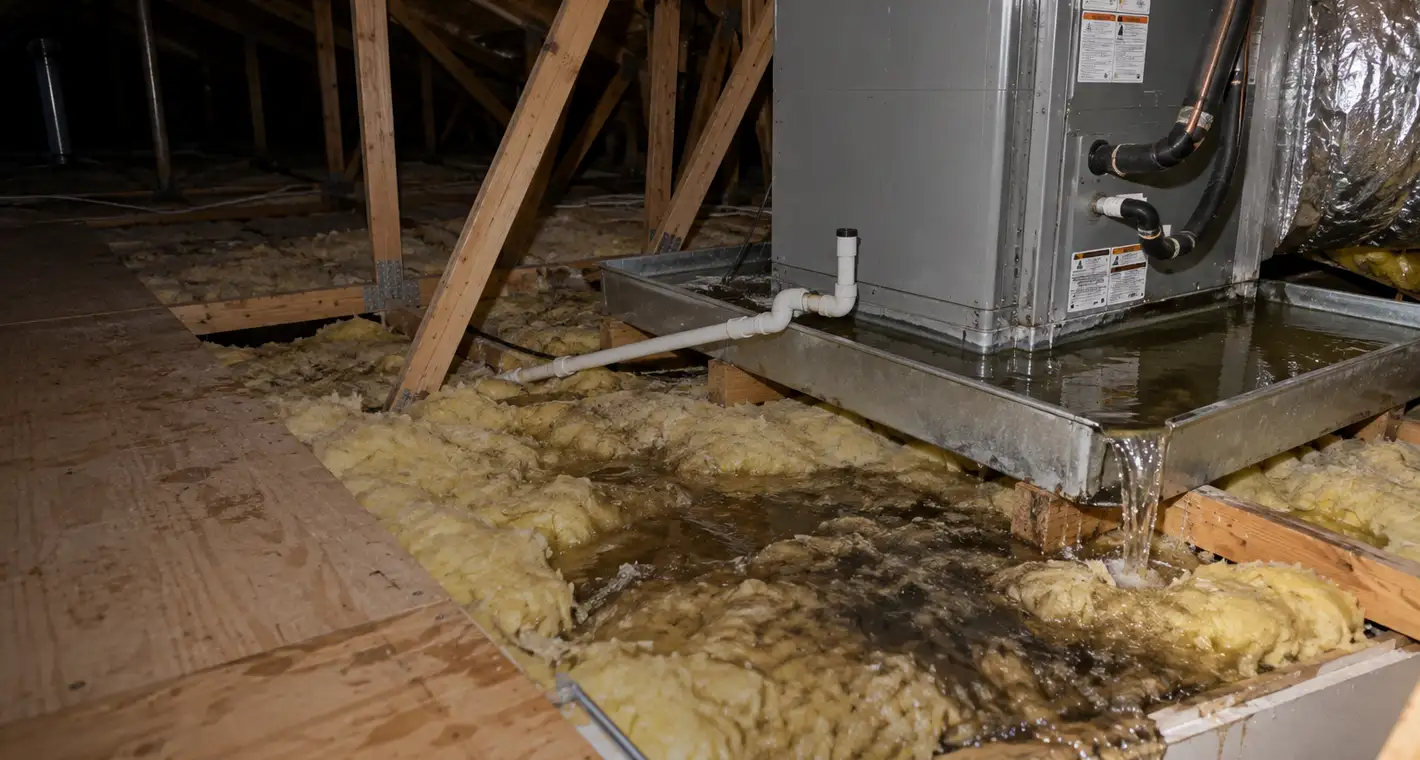
An air conditioner cools by pulling humidity out of the air, and that water has to go somewhere. It drips off the evaporator coil into a drain pan and leaves through a condensate drain line, which Florida's mechanical code sets at not less than three quarters of an inch. The line stays warm and wet whenever the system runs, and in a county where cooling runs in every month of the year, that is an ideal home for biofilm and algae. The growth thickens, the line blocks, and the pan keeps filling.
Nothing dramatic happens at that moment. Water simply leaves the pan at its low edge and follows the building. That is why a condensate loss is so often found late: there is no burst, no noise, and no pressure behind it, only a stain that appeared this week and a wall that has been wet for a month.
What the code expects, and what fails anyway
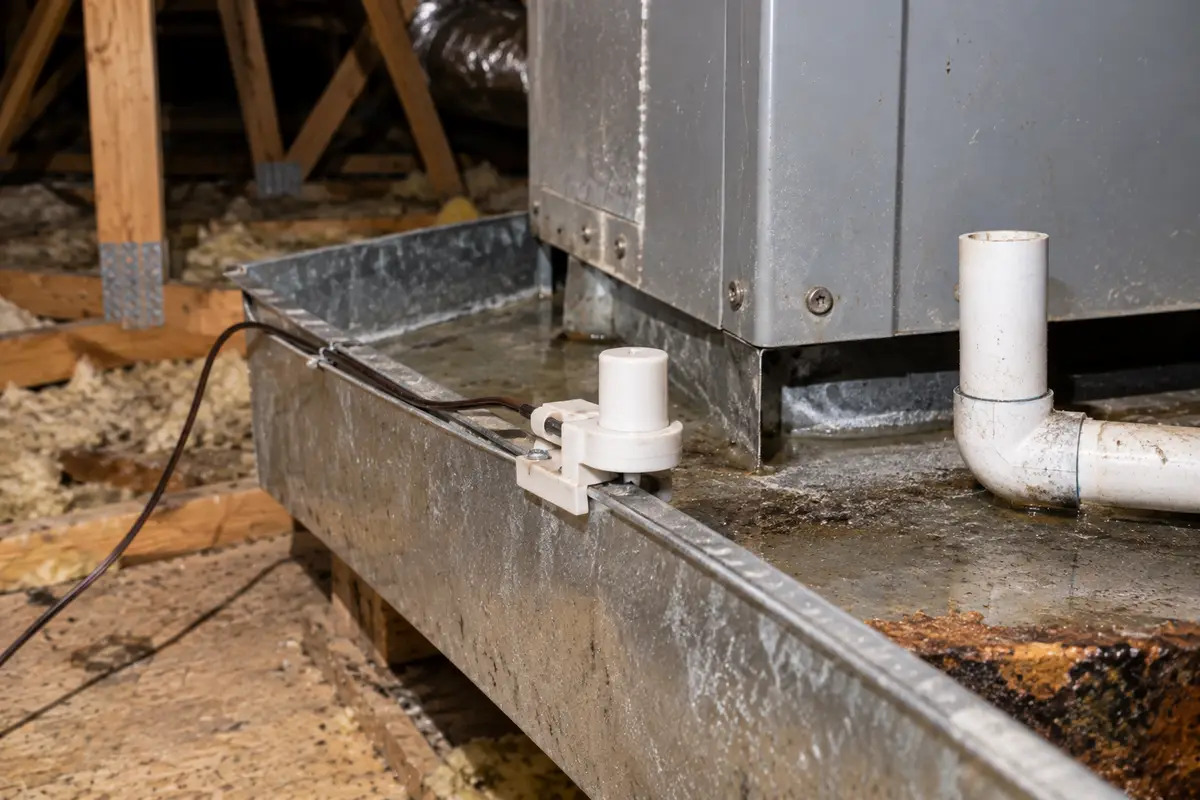
Florida's mechanical code treats this failure as foreseeable. Where an overflow would damage building components, it requires one of four protections: an auxiliary drain pan with its own drain line, a separate overflow line from the equipment pan, an auxiliary pan fitted with a water-level detection device, or a detection device that shuts the equipment down when the primary drain blocks. Any of them, properly installed, turns a ceiling repair into a service call.
In practice the protection is often not there. Equipment installed before the requirement was applied may have no float switch at all. A secondary pan that has sat in a hot attic for fifteen years can be rusted through, and near the ocean salt air shortens that further. A float switch that was wired at installation may have been bypassed during a later repair, and a secondary drain line can block with the same biofilm that took out the first one.
Attic, closet or garage: where the water goes
Placement decides the damage. In the two-story houses common in Palm Beach Gardens, Jupiter, Westlake and the newer parts of Wellington, the air handler sits in the attic or an upstairs closet, and an overflow lands on the ceiling below. Insulation soaks, drywall paper absorbs, and the stain that appears in a hallway marks the place the assembly failed rather than the size of the wet area.
In the single-story stock of Royal Palm Beach, Greenacres and the older coastal villages, the unit stands in a garage or an interior closet. There the water leaves the pan onto the floor and into the wall the closet shares with a bedroom. Drywall wicks upward from the bottom plate, the baseboard stays wet, and the first symptom is usually a smell rather than a puddle.
Drying what a condensate leak leaves behind
Wet blown or batt insulation above a ceiling is removed rather than dried; it holds water against the drywall and dries far too slowly to be worth saving. The ceiling assembly is then dried from both sides where access allows, with air movers directed into the cavity and dehumidification running to take the released moisture out of the house rather than move it into the next room. Where the loss ran for weeks in a closed house, the question shifts from drying to removal, because material that stayed wet that long in this climate has usually already supported growth.
Readings decide the end of the job, not the calendar. Affected material is metered against the same material elsewhere in the building that stayed dry, and equipment stays until the two match.
AC leak water damage West Palm Beach, city by city
- AC Leak Water Damage WellingtonZIP 33414, 33449
- AC Leak Water Damage Palm Beach GardensZIP 33410, 33418
- AC Leak Water Damage JupiterZIP 33458, 33477, 33478
- AC Leak Water Damage Royal Palm BeachZIP 33411
- AC Leak Water Damage GreenacresZIP 33463, 33413, 33467
- AC Leak Water Damage North Palm BeachZIP 33408
- AC Leak Water Damage TequestaZIP 33469
- AC Leak Water Damage Riviera BeachZIP 33404, 33403
- AC Leak Water Damage Palm BeachZIP 33480
- AC Leak Water Damage WestlakeZIP 33470
AC leak water damage West Palm Beach: questions homeowners ask
- Is this an air conditioning repair service?
- No. The providers on this site handle the water: extraction, removal of material that cannot be dried, structural drying and any remediation that follows. Clearing or replacing the condensate line, the pan or the float switch is air conditioning work and belongs to that trade. Both usually happen on the same day, because drying a ceiling while the pan is still overflowing accomplishes nothing.
- How much water can a condensate leak actually put into a house?
- More than people expect. A system cooling a Florida house in August pulls gallons of water out of the indoor air every day, and every drop of it is supposed to leave through one drain line. When that line is blocked, the same volume goes somewhere else for as long as the system keeps running, which in an empty house can be weeks.
- The ceiling has a stain but it stopped dripping. Do I still need anything?
- Usually yes. Drying stopped at the surface does not mean the assembly is dry: batt insulation above the ceiling holds water for a long time, the drywall paper has already absorbed it, and the attic above stays hot and humid. What matters is whether the material came back to normal moisture, and that is a meter reading rather than an appearance.
- Why does this happen so much more here than up north?
- Because cooling runs nearly every month, so the drain line is warm and wet all year and biofilm has no off-season. A house in a cold climate makes condensate for a few months and the line dries out in between. Add attic air handlers, humid outdoor air and coastal salt on the hardware, and the same failure that is occasional elsewhere becomes routine in Palm Beach County.
- Is condensate water clean?
- It is when it leaves the coil, since it condenses out of indoor air. It stops being clean after it sits in a pan full of biofilm, runs across attic insulation and soaks into a ceiling cavity. For the work that difference matters: a fresh overflow is handled as clean water, while one that has been running for days into an assembly is treated as contaminated and more material comes out.