
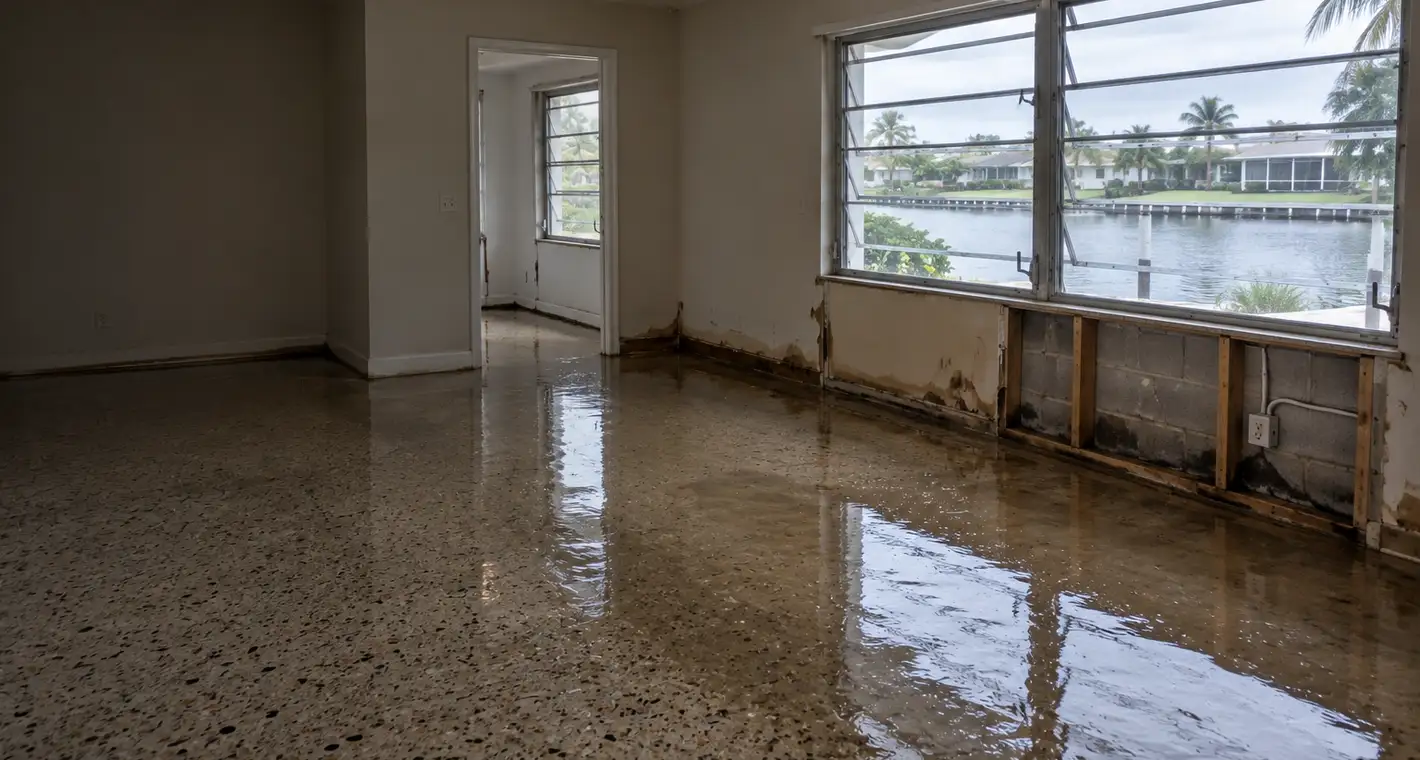
Water damage in Palm Beach
The town is a barrier island between the Atlantic and the Lake Worth Lagoon, narrow enough that many properties face water on both sides. The town maintains thirteen stormwater pump stations, and its own vulnerability assessment identifies the Intracoastal frontage as the weak edge, where bulkheads are privately owned and their heights vary from one property line to the next.
About a quarter of the housing dates from the 1960s and a fifth from the 1970s, with roughly 12 percent standing since before 1940 in the estate and historic sections. Construction is masonry with tile roofs, often extensively renovated inside an original shell, which means new finishes over plumbing and mechanical work of several different ages.
Before help arrives
- Shut the water off at the fixture or the main if you can reach it safely.
- If it is coming from a ceiling, switch the air conditioning off as well.
- Keep out of any room where water has reached outlets, cords, or the panel.
- Lift furniture off wet carpet and move what you can to a dry floor.
- Photograph the damage and the failure point before anything is moved.
Emergency water removal Palm Beach
King tides here run predictably from September into November and raise the lagoon enough that outfalls submerge. The town's pump stations exist because gravity drainage alone stops working on those days. For a homeowner the practical version is simple: rain that would drain in twenty minutes in April can stand for hours in October, and a property on the Intracoastal side with an older bulkhead has the least margin between a wet lawn and water at the door.
Burst pipe cleanup Palm Beach
A house from 1965 that was renovated in 2005 and again in 2019 has three plumbing generations in it, and failures come from the oldest one left in place. Drain lines from the pre-1975 era are cast iron; supply runs from mid-century are galvanized or early copper. Renovations replace what is convenient and leave what is buried, so the line that fails is normally the one behind the wall that nobody opened.
AC leak water damage Palm Beach
Large houses run several air handlers, often in attics and mechanical rooms above finished ceilings, and each one has a condensate line that has to stay clear. Salt air corrodes pans and hardware. Florida's mechanical code requires a secondary pan or a shutoff device where an overflow would damage the building, but on older equipment those parts may be rusted, disconnected or never wired. In an empty house nothing interrupts the process.
Mold remediation Palm Beach
The seasonal pattern is the whole story. A house closed in May and reopened in November has spent the humid half of the year without anyone watching it, and a leak that started in June has had five months. What matters then is how far it went: growth on a wall surface is a cleaning problem, growth inside the assembly behind furring or under a rebuilt cabinet run is a removal problem, and only a proper inspection separates the two.
Drying a Palm Beach home
Renovated older houses are the hardest to read. Layers accumulate: tile over an older floor, new cabinetry on original masonry, plaster in one room and drywall in the next, and each layer dries at its own rate. Meters are used on every material separately, and drying continues until the slowest one matches its dry baseline rather than until the room looks finished.
The sequence is set out in full on the water extraction and drying page for Palm Beach.
Services available in Palm Beach
- Water Extraction & DryingStanding water pulled out, then the structure dried under daily moisture readings.
- AC Leak Water DamageCondensate that backed up out of the drain pan and went into the ceiling or the wall.
- Sewage CleanupContaminated water handled with containment, removal and cleaning.
- Mold RemediationGrowth that established while wet material sat in a warm, humid house.
Areas covered in Palm Beach
Water Damage Restoration Palm Beach FL reaches the whole municipality, including the North End, Midtown, the Estate Section, the South End, Everglades Island, Ibis Isle and the Worth Avenue district. ZIP codes: 33480.
Water Damage Restoration Palm Beach FL: questions homeowners ask
- Does a historic designation change how the repair is handled?
- It changes the reconstruction rather than the drying. Emergency work, extraction and structural drying proceed the same way. Replacing original plaster, windows or exterior material in a landmarked property involves the town's review process, so it is worth telling both your provider and your insurer early that the property is designated, so that the scope is written with that in mind.
- Water is coming through a ceiling on the second floor. What should I do first?
- Shut the water off at the main if the source might be plumbing, and shut the air conditioning off if the ceiling is below an air handler. Do not push on a sagging ceiling. Photograph everything, move what is beneath it, and put a container under the drip. A ceiling holding water can fail as a sheet, and the safest sequence is to have the person who arrives relieve it deliberately.
- Is salt in the air really a factor inside the house?
- It is for hardware rather than for finishes. Condensate pans, fasteners, coils and metal fittings within a few blocks of the ocean corrode measurably faster, which shortens the life of the parts that are supposed to prevent a water loss. That is a maintenance point rather than a restoration one, but it explains why so many island condensate failures start with a pan that had already rusted through.
- The house is closed for the summer. What monitoring is actually worth installing?
- Two things do most of the work: a water sensor at each air handler pan and under the water heater, and a humidity sensor that reports to a phone. Both are inexpensive and both catch the failures that do the most damage in an empty house. A whole-house shutoff valve that closes on a leak signal is the next step up and is worth considering where nobody visits weekly.