
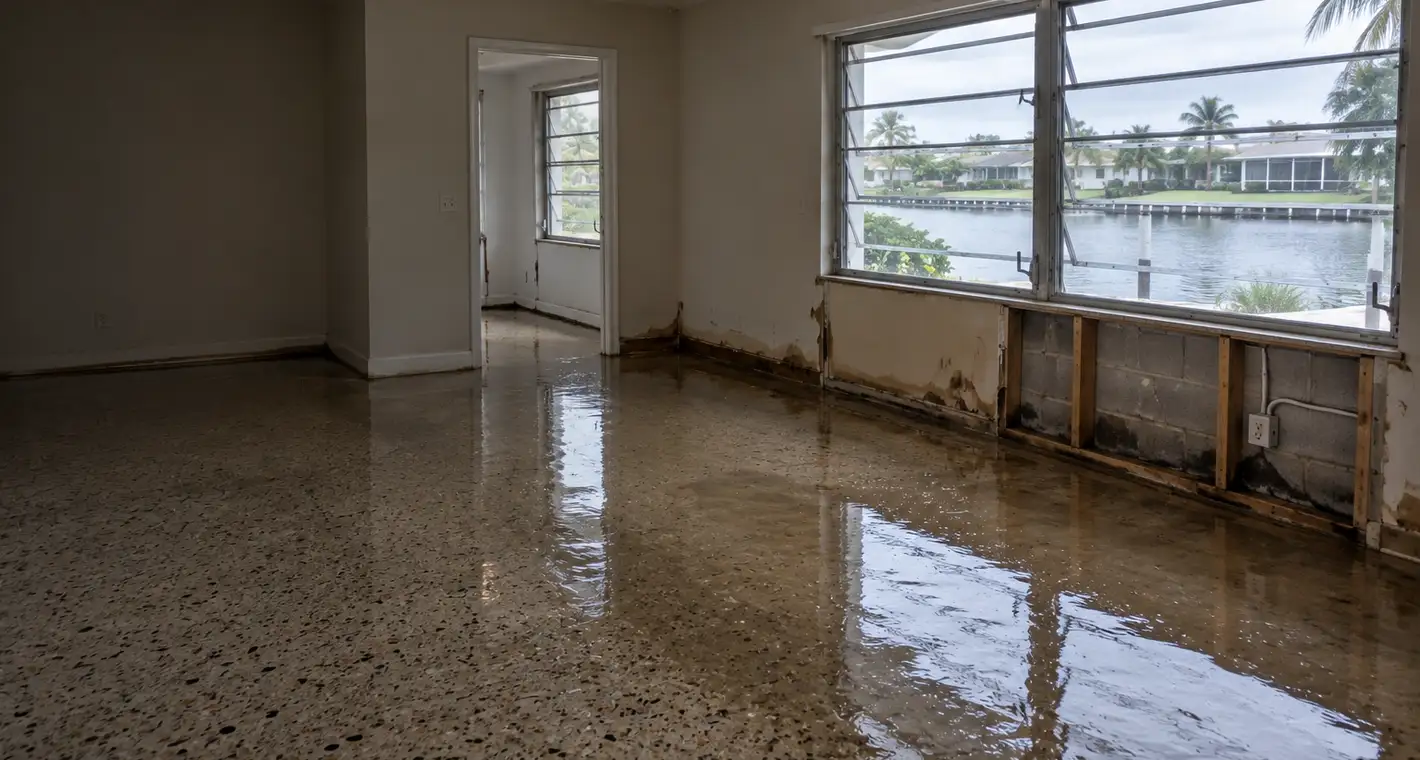
Water damage in Riviera Beach
The city runs from the mainland across the Lake Worth Lagoon to Singer Island, with the Port of Palm Beach and the inlet at its southern edge and Palm Beach Shores occupying the island's south tip. Elevations near the water are low, storm drains discharge into the lagoon, and the city's own utility district serves roughly thirteen thousand connections across about ten square miles.
Housing splits by decade and by location. West of US 1 the neighborhoods are largely 1950s and 1960s single-story block, about 47 percent of the city's stock predating 1980, while the 2000s added roughly a fifth of the total, much of it on and near the island. The mainland houses are the ones still on their original drain lines.
Before help arrives
- Shut the water off at the fixture or the main if you can reach it safely.
- If it is coming from a ceiling, switch the air conditioning off as well.
- Keep out of any room where water has reached outlets, cords, or the panel.
- Lift furniture off wet carpet and move what you can to a dry floor.
- Photograph the damage and the failure point before anything is moved.
Burst pipe cleanup Riviera Beach
The mainland neighborhoods were built when cast iron was the standard drain material and galvanized steel was common on the supply side. Both have well-known end-of-life behavior: galvanized restricts and weeps at threads, cast iron corrodes from the inside and finally opens under a slab. Neither failure is dramatic at the start. A damp patch on a hallway floor, a persistent smell, or a section of tile that lifts is what a fifty-year-old drain line looks like when it fails.
Emergency water removal Riviera Beach
Autumn king tides raise the lagoon high enough that storm outfalls stop working, and rain that falls during those days has nowhere to go. Combine that with a slab set close to grade and a lot that drains toward the house and water arrives at the threshold without a hurricane being involved. On the island, the mechanism is different but the timing is the same: wind-driven rain and surge during a storm, salt water on the floor rather than fresh.
AC leak water damage Riviera Beach
Salt air is hard on air conditioning hardware, and the drain pan, the fasteners and the pan fittings corrode faster within sight of the water. A rusted secondary pan does not catch anything. Add the standard Florida cause, a three-quarter-inch condensate line that grows biofilm and blocks, and the overflow goes into a closet wall on the mainland or through a ceiling in an island condominium. Neither is visible until material is already wet.
Mold remediation Riviera Beach
Warm, humid, and often coastal air means a wet assembly stays wet. In block-and-furring construction, which is what most of the mainland housing is, moisture ends up in the narrow gap behind the drywall where nothing reaches it. Remediation is about containment and removal of the affected material rather than surface treatment, and it should be followed by drying that is verified with readings rather than assumed.
Drying a Riviera Beach home
Older block houses with terrazzo or tile give water a fast, flat path and hold it at the wall base, so the drying plan follows the perimeter rather than the room. Anything within a few blocks of the lagoon or the ocean is also drying into humid, salt-laden air, which is a reason equipment runs on a closed house rather than with the windows open.
The sequence is set out in full on the water extraction and drying page for Riviera Beach.
Services available in Riviera Beach
- Water Extraction & DryingStanding water pulled out, then the structure dried under daily moisture readings.
- AC Leak Water DamageCondensate that backed up out of the drain pan and went into the ceiling or the wall.
- Sewage CleanupContaminated water handled with containment, removal and cleaning.
- Mold RemediationGrowth that established while wet material sat in a warm, humid house.
Areas covered in Riviera Beach
Water Damage Restoration Riviera Beach FL reaches the whole municipality, including Singer Island, Monroe Heights, Riviera Beach Heights, Inlet Grove, Park Manor, Palm Beach Isles and the Blue Heron Boulevard corridor. ZIP codes: 33404, 33403.
Water Damage Restoration Riviera Beach FL: questions homeowners ask
- I live in a condominium on Singer Island. Who is responsible for the drying?
- Your association's documents draw the line, usually at the unit's finished surfaces, with the building responsible for common elements including the pipes inside shared walls. In practice a water loss in a stack affects several units, and readings need to be taken in all of them. Report it to the association the same day you call for help, because their carrier and yours will both want the early documentation.
- How fast does water get from an upstairs unit into mine?
- Minutes, not hours. It follows plumbing chases, the tops of walls and light fixtures, and it lands wherever the assembly first gives it a path. That is why the unit that reports the leak is often not the unit where it started. Turning off the water at the affected unit and getting eyes on the ceiling below is the first useful step in a multi-story building.
- Is a 1958 block house worth drying or should material just come out?
- Both, in the right order. The block and the slab are dried; the materials attached to them are judged individually. Baseboards, cabinet kicks, the lower band of drywall and any wet insulation usually come out because they hold water against the structure. What stays is what can return to normal moisture without deforming, and that decision is made with a meter rather than by eye.
- Salt water got into the house during a storm. Does that change the work?
- It does. Salt water is corrosive and it does not simply dry away: salts stay in porous materials and in metal fasteners, holding moisture and attacking anything ferrous long after the surface is dry. Affected porous material is removed rather than dried, hard surfaces are rinsed and cleaned rather than only dehumidified, and electrical components that were submerged are treated as compromised.